Never be afraid to paint outside the lines

Tag: red+turquoise

Steamthing, revisited

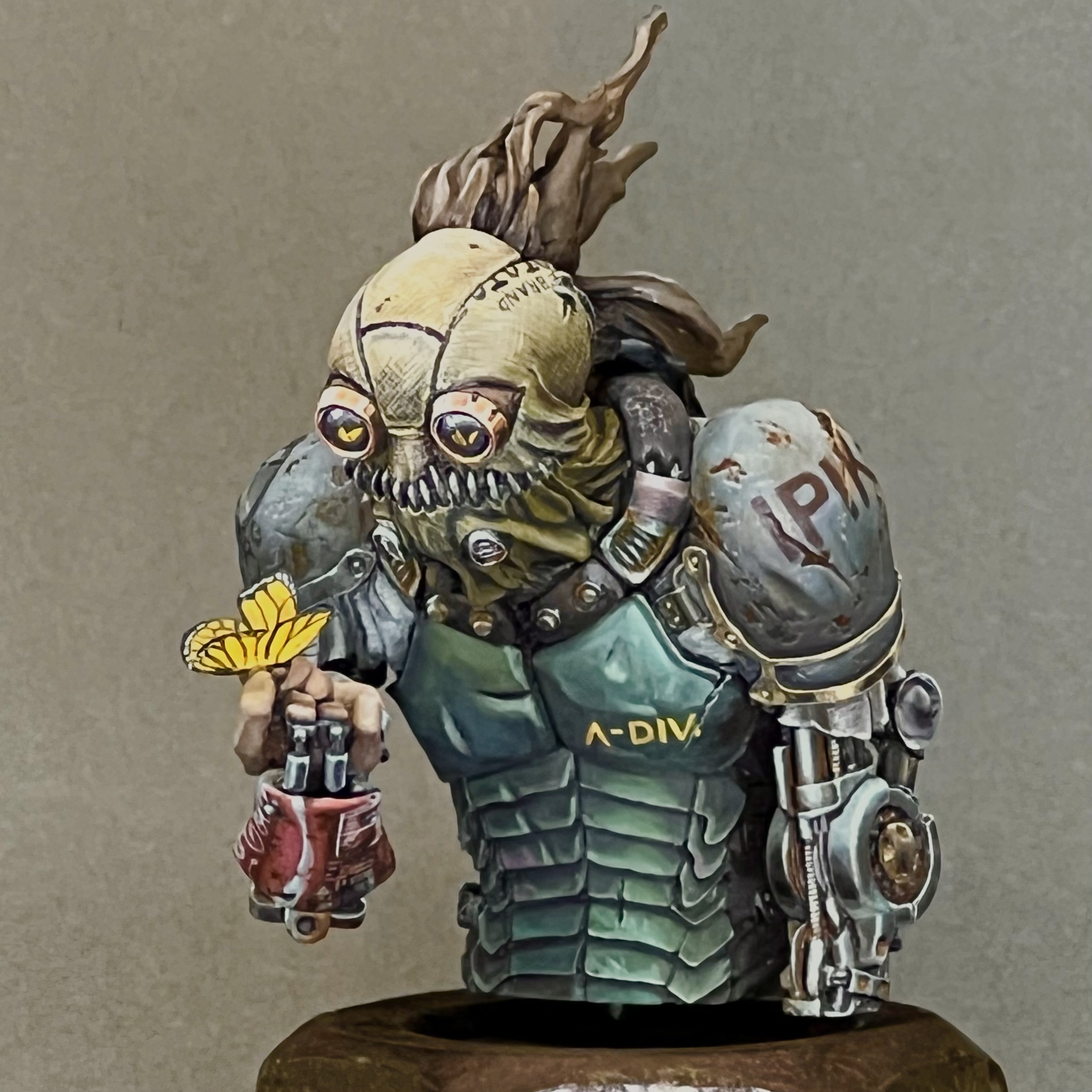
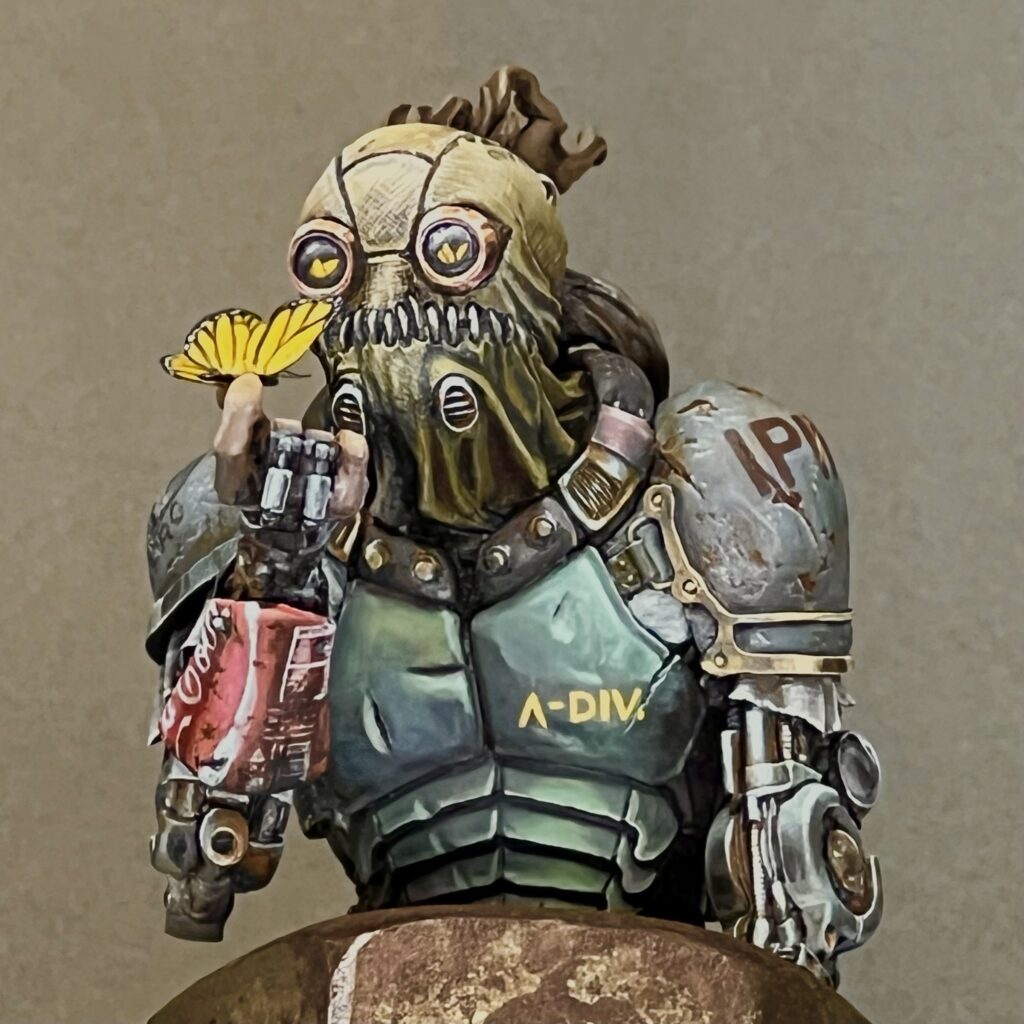
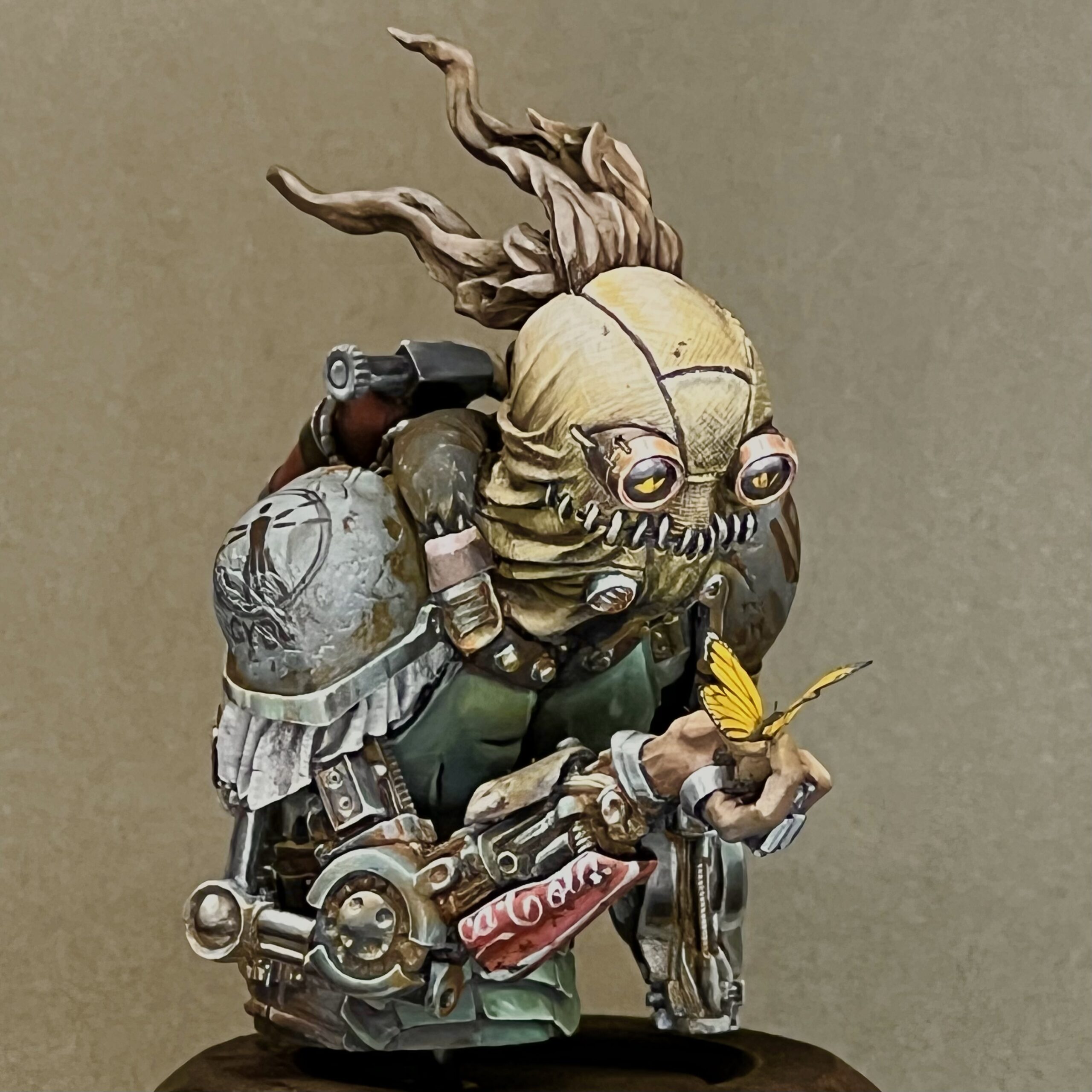
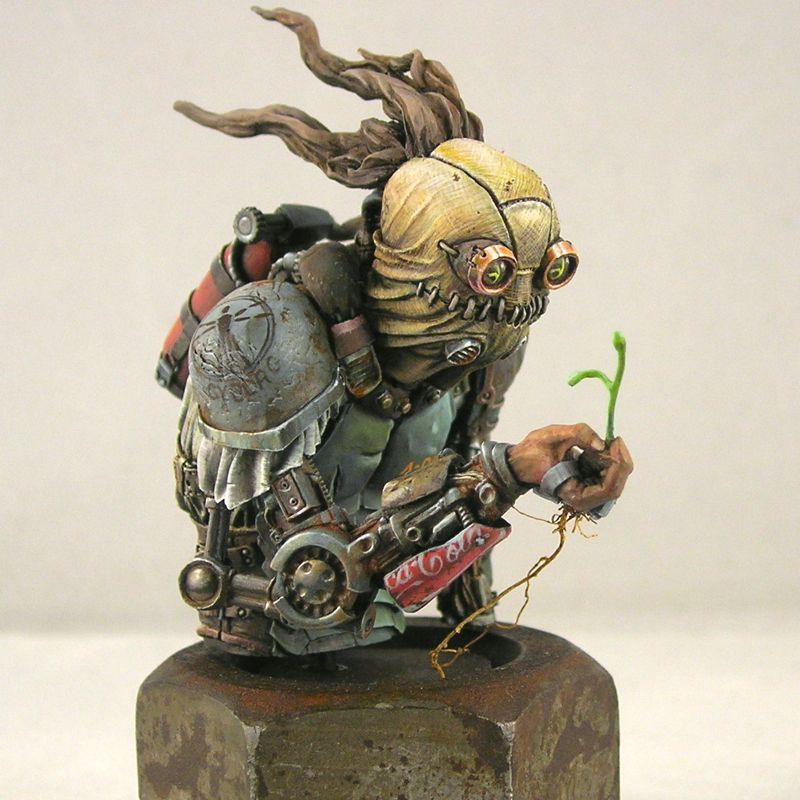
A couple years ago I decided to make a slight tweak to my Steamthing, IPIK-7 bust. He was originally sculpted holding a plant, and even though I replaced it with my own plant and added roots, I kept the sculptor’s original intent. More photos of my original version here.

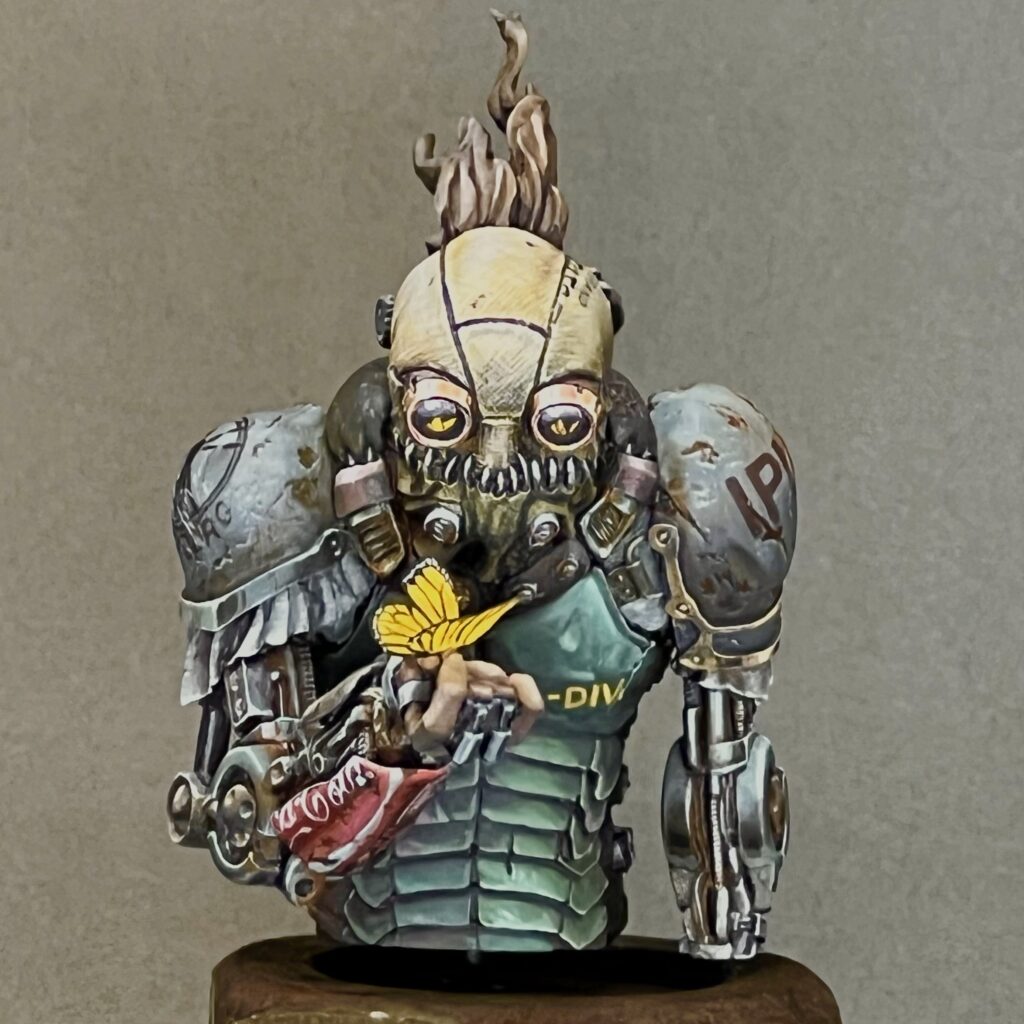
When a friend gave me some laser-cut vellum butterflies to play with, I thought it would be cool to replace the plant with a butterfly. I really like what this does to the figure. It keeps the strange juxtaposition of some kind of weird post-apocalyptic creature perplexed by encountering nature, but in a non-destructive way (instead of the original uprooted plant).

IPIK-7 had never seen such beauty

Also, by replacing a green element with a yellow one, I ended up with an overall color-composition I’m happier with. The color scheme becomes something like a primary triadic one, rather than the original which was a bit all-over-the-place. I sometimes like all-over-the-place color schemes (the mermaid I just posted is a good example), but I find that I have a hard time integrating green into such a color scheme, and I am overall much happier if I only use green in simpler color compositions.

IPIK-7 is puzzled by the flapping wings

My favorite part of the paint job continues to be the coke can. I imagine Steamthing as a post-apocalyptic cyborg using found materials to replace components as they wear out, and I thought no object would represent that better than the iconic Coke can. I especially enjoyed including the regulatory labeling and only half the logo. If you’re curious, I shared a lot more thoughts about the painting in my original post on Steamthing.

IPIK-7 is entranced by the yellow

Also, some of the roots broke off while transporting him to and from conventions, so I had to do something. 😉😛

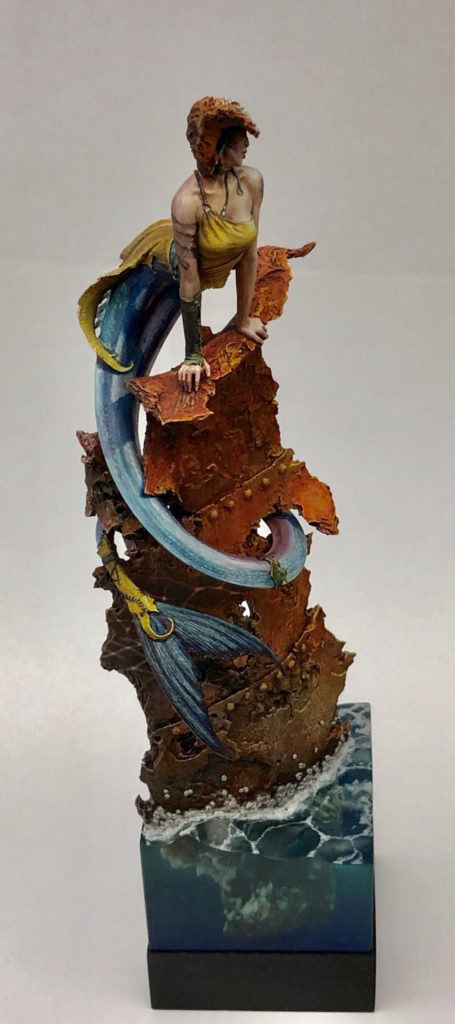
Mermaid – Part 2 – Painting

I’m not someone who believes in always priming black or always priming white. I usually have a vision for a model before I start painting it, and then prime using whatever technique I think will make it easiest to achieve that vision. Which is not to say that things always end up matching my initial vision, but at least that’s how they start.

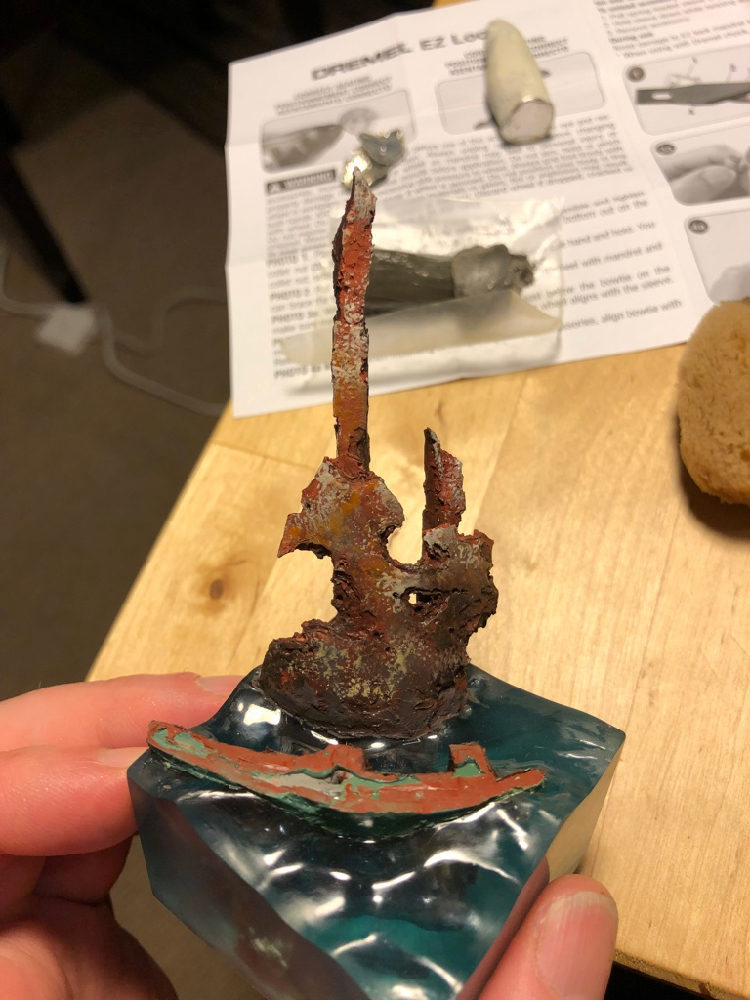
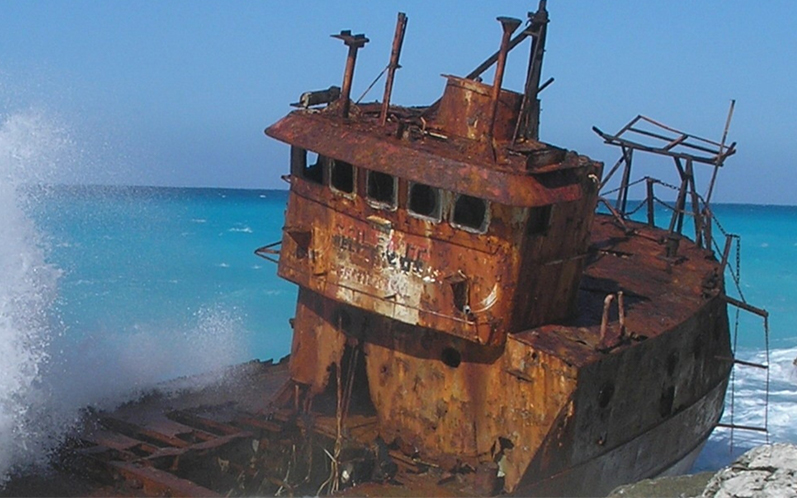
Red oxide primer was an obvious choice for the mermaid’s giant rusty shipwreck, and I dusted white over it to start suggesting light and bringing out shapes. I primed the mermaid herself white, since I wanted her to be bright and colorful.

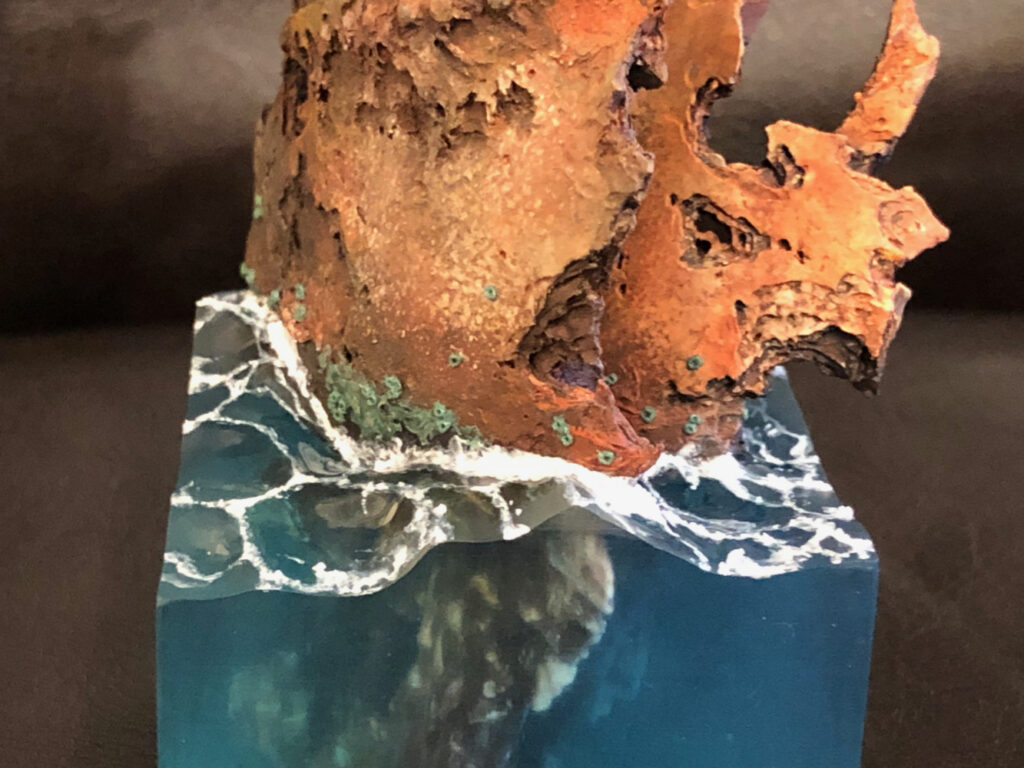
After putting all that effort into the water, I decided to start on the base first. I used a natural sponge to start putting in texture and adding different colors. I really like natural sponges, as they have a lot of interesting textures which are very different from the sponge-painting textures you would get using synthetic sponges or foam.

I looked at a lot of reference of shipwrecks to get an idea how to paint it realistically, and one thing they all had in common was a lot of different colors, from yellows to oranges to reds to browns, and even some purple and gray. I used this first to inform the colors of my sponge-painting, and then later when it came to start refining with a brush.

Once both pieces of shipwreck were fully sponge-painted and the highlighting and shading was started, I put them together and hid the join with greenstuff. Sponge-painting works best on flat surfaces, so I wanted to finish that step before attaching the pieces. But I also like to get things assembled as quickly as possible so I can refine all of the parts together and see the composition as a whole.

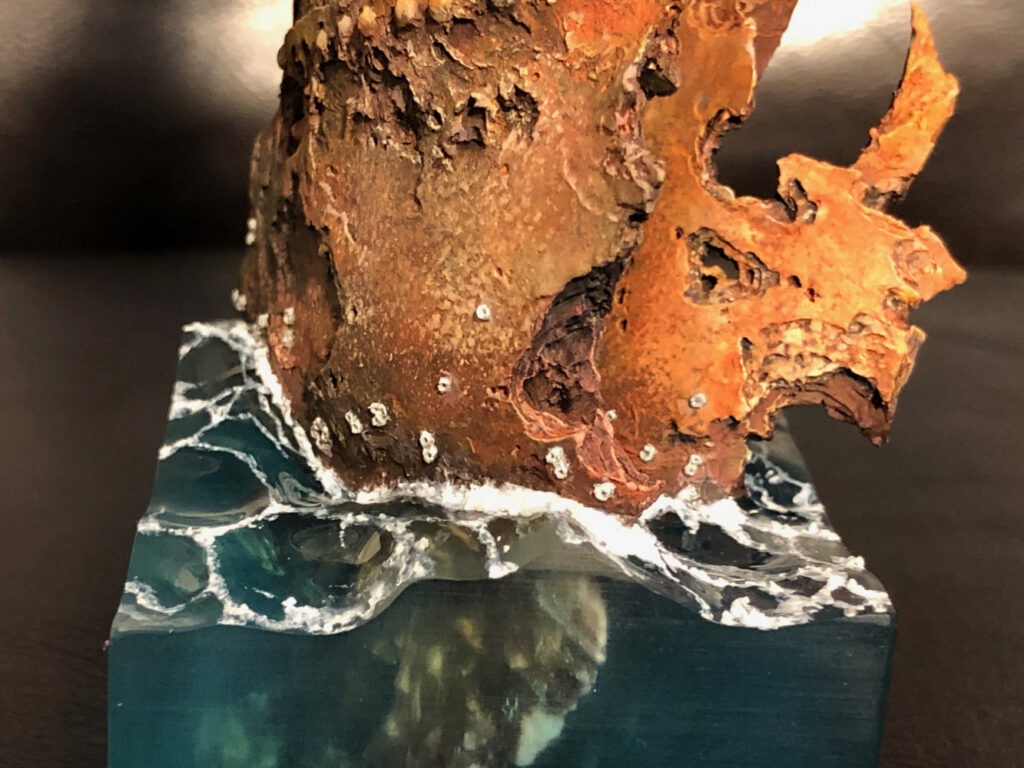
When I attached the shipwrecks to the base, I also added a few barnacles. Eventually I would decide a lot more barnacles were needed.

I prefer to start very sketchy, and refine gradually. Working this way I think helps a lot with composition and establishing overall contrast. Here (above) is the “initial sketch” – the first point where all of the primer is covered with paint, the model is fully assembled, and I can start to judge the composition and determine where I may need to make adjustments. In this photo, the mermaid is just pinned into the shipwreck, and her tail is two pieces just pinned together. I knew I wanted to do a lot more work on the tail especially, and would want easy access.

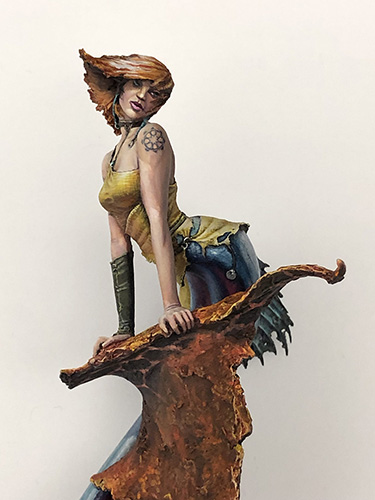
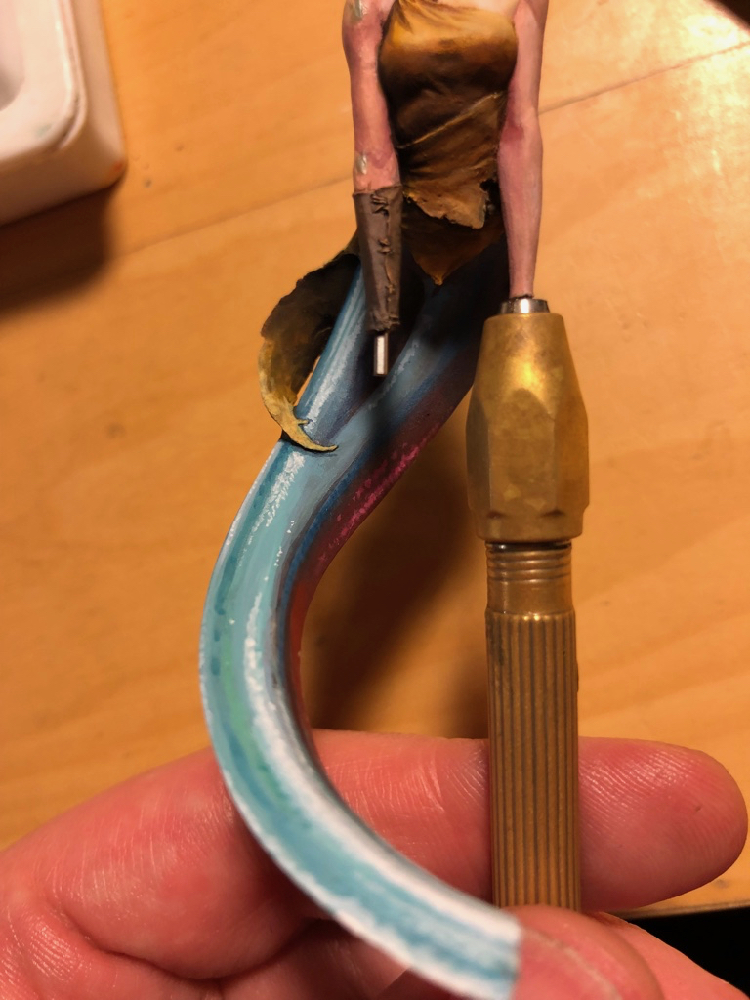
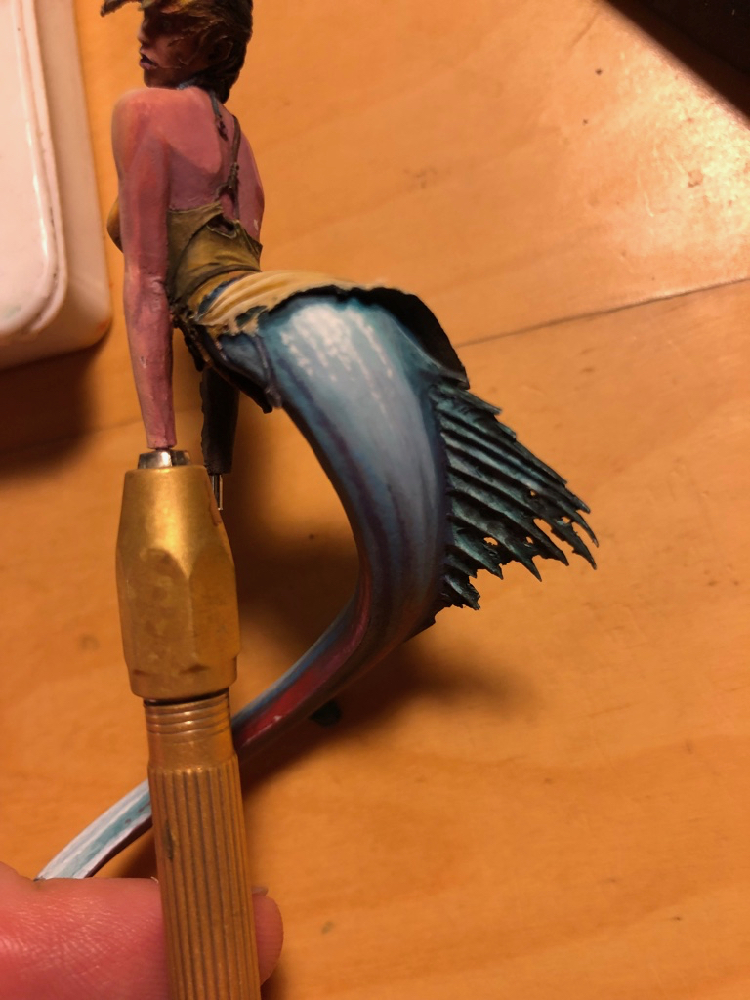
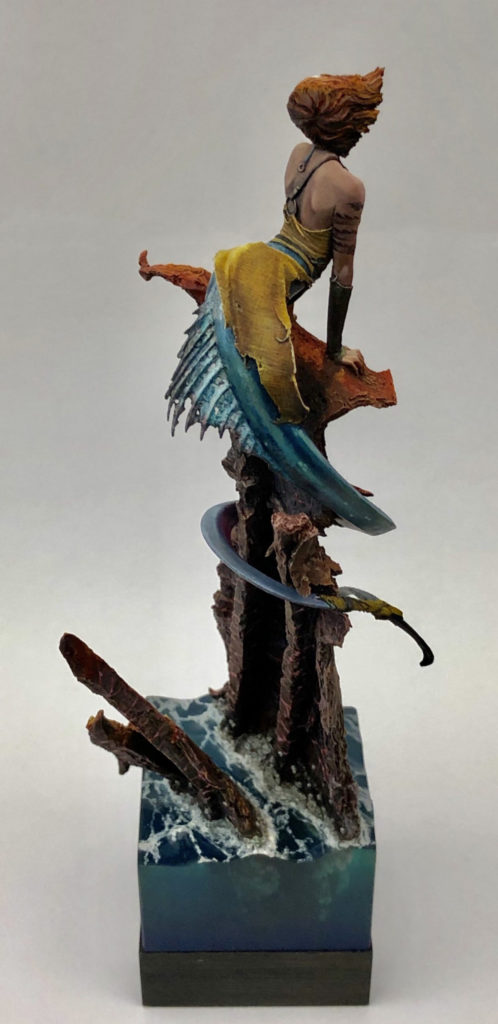
I wanted the tail to look very sparkly, with suggestions of iridescent scales, so I painted with lots of bright colors and small dots. I used magenta and red on the side that would be towards the rusty shipwreck, to suggest a reflection from the red rust.

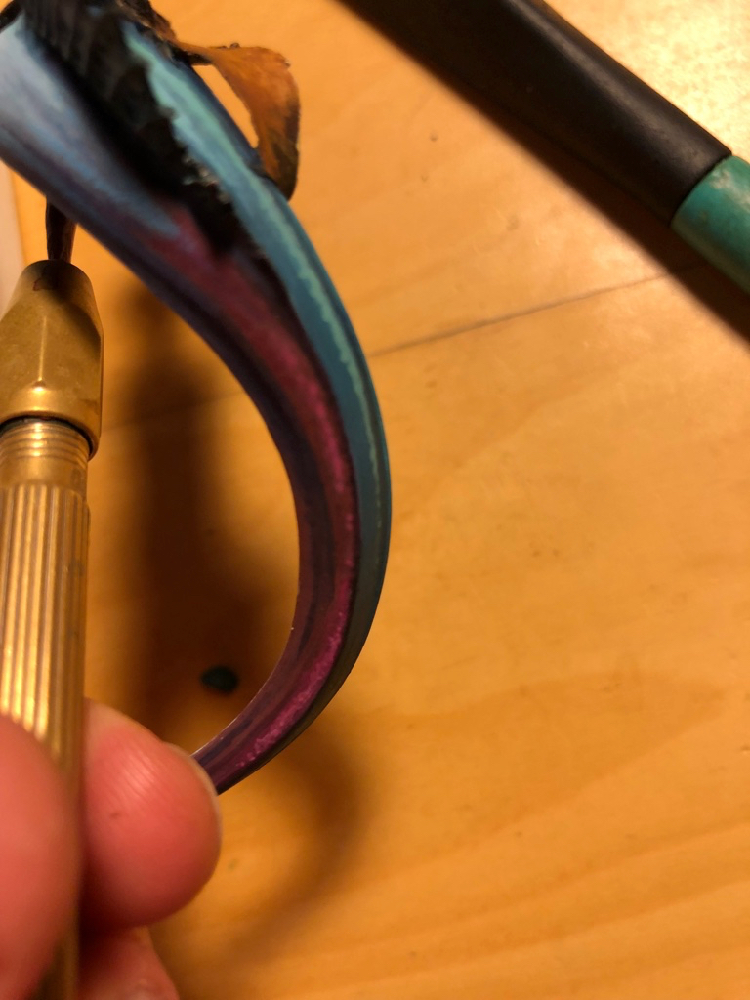
Here is another angle on the purple reflection. Initially, I planned to use non-metallic paints to suggest a shiny tail, but I was never 100% happy with this approach. In the end, I decided to do thin glazes of metallics over the nmm, which I was much happier with. I used the scalecolor metallics set for this, since it has lots of interesting colors, with a very fine, translucent flake, which worked well for this purpose. I also used some pearlescent inks from Daler Rowney, which worked well for a similar reason.

This stage is the last WIP photo I took. In fact, a ton more work went into the mermaid after this stage. But since I paint very organically, often there are not big obvious changes that happen after the initial sketch phase, just slow, gradual refinement, which makes it less obvious when to take photos.

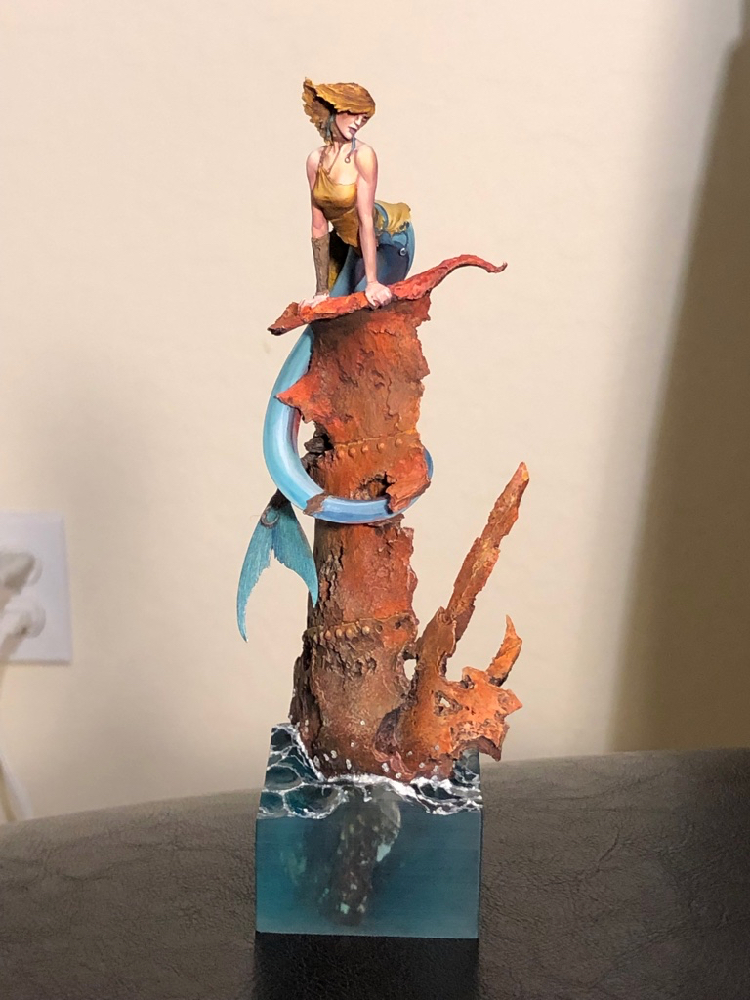
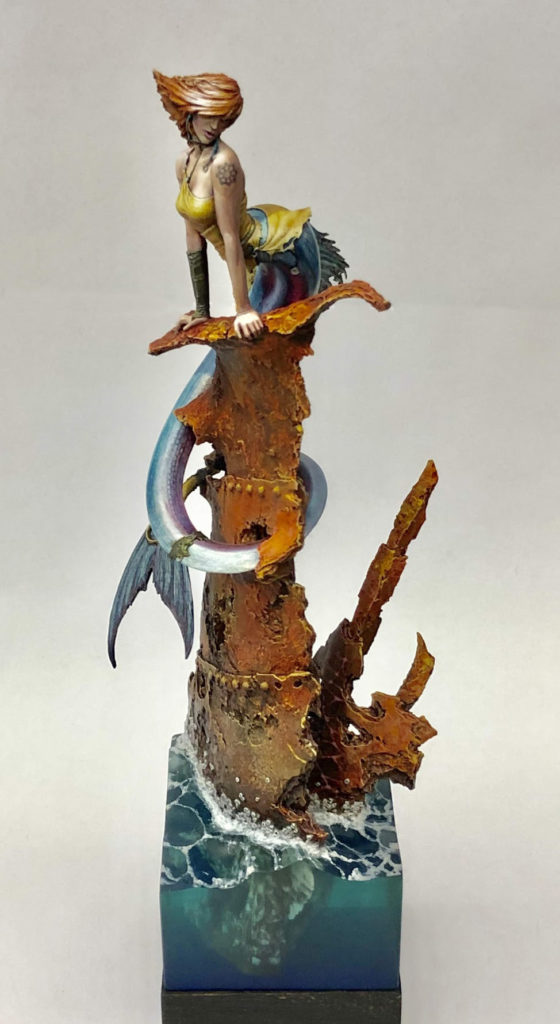
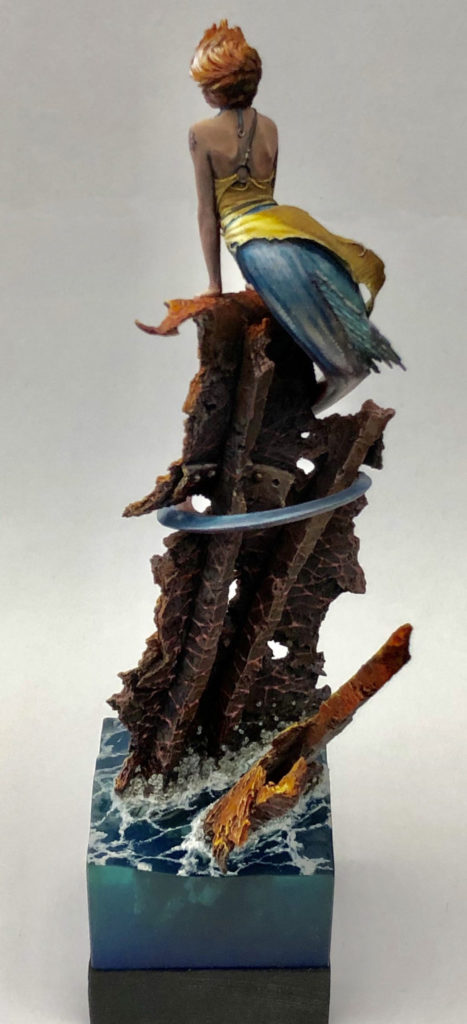
And here’s the finished figure! I took her to Crystal Brush 2019, where she did not make first cut (unlike my other figure). I solicited a number of critiques after this disappointment, and followed a number of suggestions as a result. The first change was the hair color. My initial idea, was to do sun-bleached hair, but it didn’t read that wall and generally looked bad. Instead, I made her a redhead, which worked a lot better on its own terms, and also helped to connect the color palette of the figure with the base.

The second big change after Crystal Brush was using a blow-dryer to heat the entire shipwreck enough that I could twist it. Yes, this was as nerve-wracking as it sounds. But one piece of feedback I got was that the best viewing angle was not edge on, so I wanted to twist the figure enough to make the best viewing angle match with one of the flat sides.

Whenever you put a figure on a base or plinth with flat sides, you should always design the layout so that the best viewing angle is edge on, rather than facing one of the corners or some other angle. You want the viewer to look at the figure from the right angle, don’t you? Most folks’ natural habit is to look at figures from one of the flat sides. Don’t try to get people to deviate from this habit; instead, use it to your advantage.

I did plan in advance for the best viewing angle to be edge-on. I was just wrong about what the best viewing angle would be once she was painted. Hence the twist to compensate.

Another change I made after crystal brush was adding the caustic reflections. This was great fun to do, and IMO makes for a cool little detail.

I also painted caustic reflections in back. They don’t actually make physical sense, since the sun is at the wrong angle to bounce light in that direction. But they look cool, and add interest to what is otherwise a less interesting viewing angle. Rule of Cool trumps physics.

After the revisions, I entered her in another painting competition, Kublacon (my home turf). The Kublacon painting competition was especially competitive that year, with both Steve Garcia and Matt DiPietro visiting to teach classes, and also Anne entering her Crystal Brush entry, Sacrifice [NSFW]. I was very pleased to take Best of Show with such a stacked field.

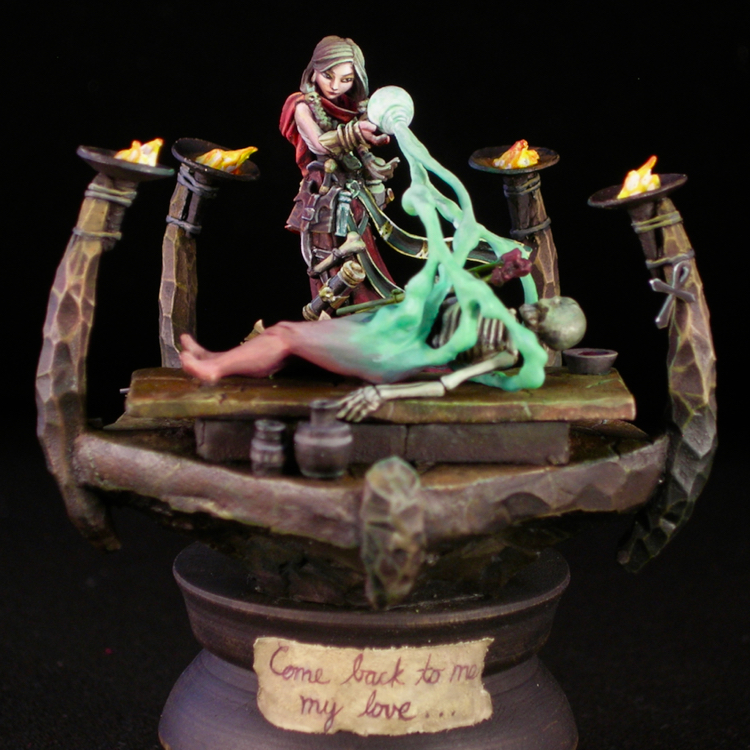
Come back to me, my love…

Adriana and Nymera’s relationship with the other villagers had always been poor. Two women living together inevitably branded the pair outcasts and brought on whisperings of witchcraft. In this case, the rumors were true. Not that they had ever used their powers to harm anyone. In fact, on two separate occasions, villagers had miraculous recoveries from death’s doorstep thanks to Adriana’s unseen interventions. But far from helping the couple’s reputation in the village, these miracles had instead cemented the power of the rabble-rousing preacher Fillius. As his sermons against the witches became filled with fire and brimstone, Nymera and Adriana made preparations to find a new home.

* * *

When Adriana approached the house and saw the door ajar, a spear of ice stabbed her heart. Silently chanting, “please, no, please, no,” she peered through the doorway. The disarray inside confirmed her worst fears. Turning on her heel, she rushed towards the church. Maybe there was still time to save her love. The blackened stake in front of the church burned that last hope to cinders, replacing the ice in her heart with fire.

Listlessly, not knowing her purpose, she sifted through the charred wood and ashes. When she found the bones she needed, she realized why she had been searching. There was a book she had read in her youthful researches: one filled with spells she had sworn she would never use. One spell in particular, blacker than the darkest night, required a human heart for its workings. Life could be restored, but only at deadly cost.

She knew just whose heart she would use…
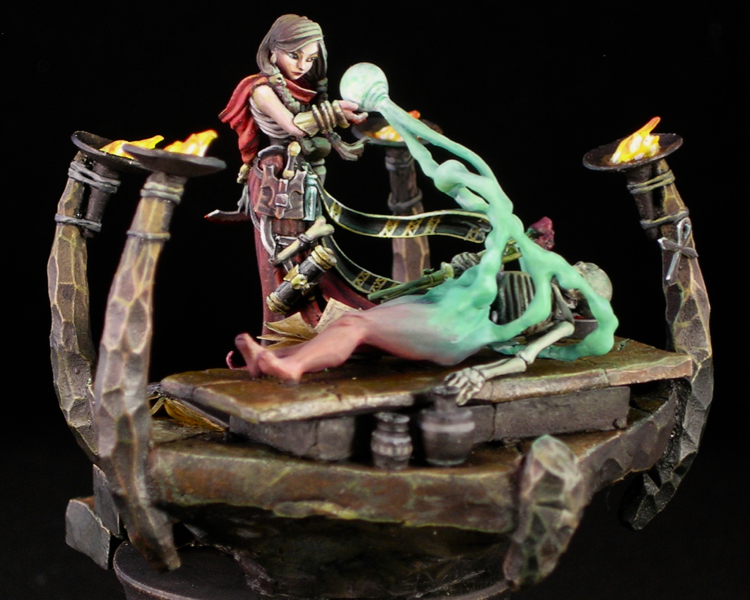
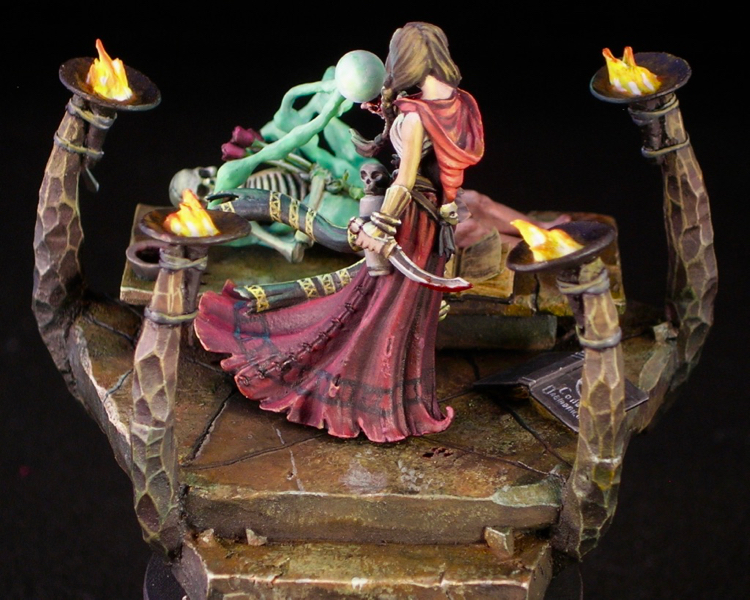
This was a really fun project. When I was thinking about ReaperCon projects this year, and settled on painting this lovely necromancer (03784: D’Vandra Lukesia by Bobby Jackson), I decided to do something a bit ambitious. D’Vandra comes equipped with a shovel, and something about a shovel-wielding necromancer just cries out to be raising the dead. I began mentally composing a graveyard scene, but in the end I decided that I just didn’t want to deal with all that dirt. So I swapped the shovel for a ritual blade, and replaced the graveyard with an unholy altar, upon which our heroine would resurrect her lost love.
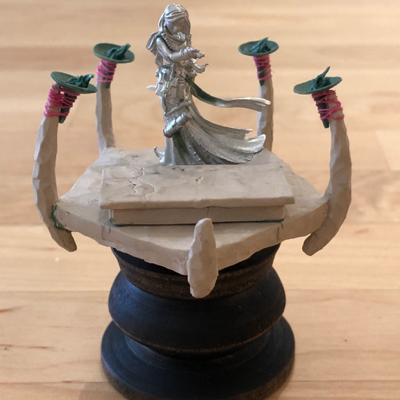
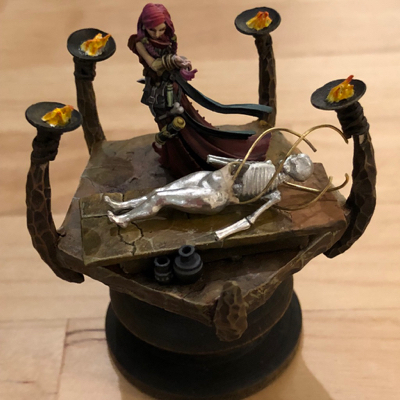
With the exception of the two figures and the urns, the scene is entirely scratch-built. The altar is composed of PC-Lumber two-part epoxy putty over a frame of cork tile. I like to use cork tile to test out shapes quickly and easily, and also save on putty. PC-Lumber is a great putty to use for terrain construction. It hardens very quickly, it cures rock hard, and it holds texture reasonably well. Its hardness makes it ideal for structural use, where a more flexible material like green stuff would bend slightly. It also means it holds crisp corners, which is useful for doing architectural details. For stone work, I like to alternate between adding material and subtractive sculpting, where I carve or break away material. I find that this process results in more natural shapes and textures. Because this particular putty cures hard enough to carve in about 45 minutes, I can do several cycles of this alternation in a day’s work.

The torches themselves are green stuff, as you can see in the photo above. Originally, I tied them to the stone pillars with thread, which is what you see in the photo. However, the thread was noticeably fuzzy when primed, so in the end I had to replace it with green stuff ties.
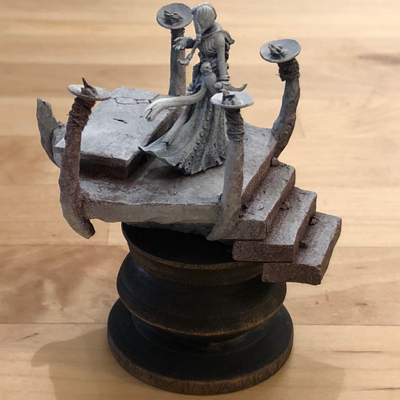
I used zenithal priming for both necromancer and base, as I do for most of my figures. With the base, I did an intermediate step with a red oxide primer, after the black and before the white. I deliberately made the red oxide primer fuzzy and lumpy, by holding the nozzle of the paint can only part-way down. This makes the paint spray in larger droplets, creating a texture over the surface. This texture would be a disaster when priming a figure, but actually works quite well for rock and corroded metal. It was a bit of a problem for the flames however, and I ended up needing to use gloss varnish to smooth out the texture on the flames before painting them. Were I to do this over again, I would cover the flames with little blobs of blue tac when priming, in order to avoid that problem.
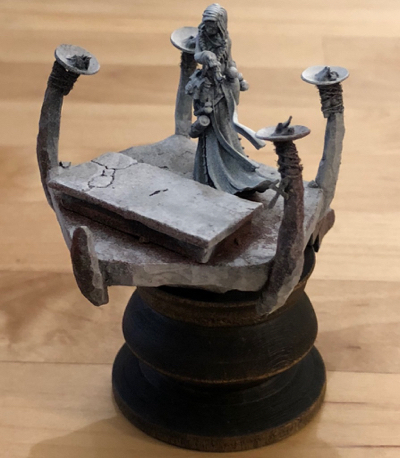
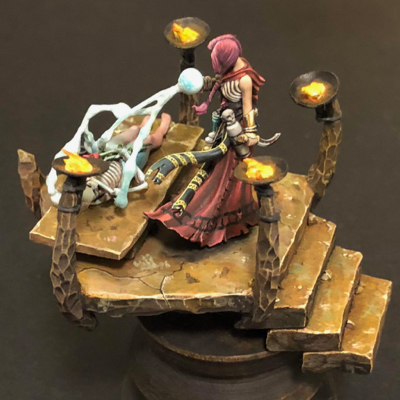
I started painting with just the basic structure in place, and added more details as I went, such as the resurrected body, urns, and books. Partly that was because things were easier to paint separately, but mostly it was because I didn’t have the parts I needed for the corpse when I started working on the project, and I didn’t get the idea for the books until half-way through painting.
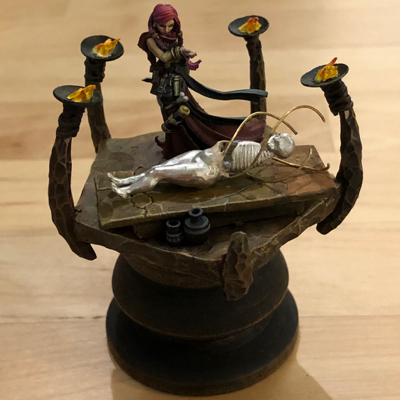
The corpse is converted from 03639: Bella, Succubus by Patrick Keith, and Secret Weapon’s skeleton kit. The spell effect I used to merge the two, showing flesh forming over bone out of ectoplasm, is made from putty over a brass wire armature.
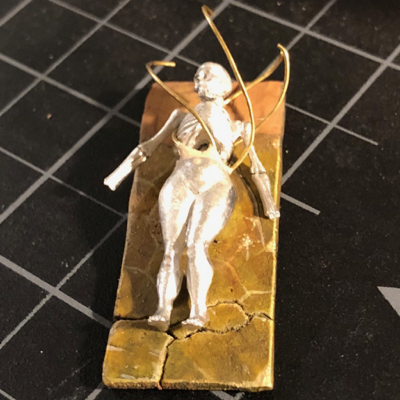
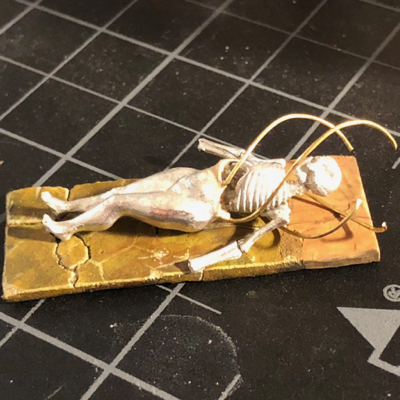
After anchoring the wire to the corpse, I ended up playing with it quite a bit in order to find a design I was happy with. Originally it was spiraling out from left to right, but I decided I wanted more interaction between the corpse and the necromancer. Then it went through a phase where it it was coming in from her general direction in thin wisps.
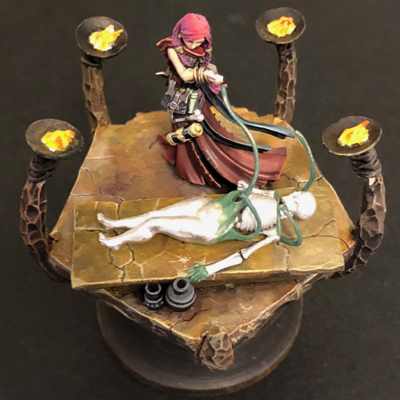
One problem I had to solve was how to ensure the viewer interpreted the spell being cast as resurrection, and not disintegrate. I combined several ideas in order to make this as unambiguous as possible. The first idea was to have the body forming from left-to-right in the main view, since English readers are used to things starting on the left. The second idea was using a cloudy spell effect, which I thought would look more like matter being formed from vapor, rather than being blasted into dust. I was also happier with the spell effect once I added a bit more structure to it, making it look like clouds rather than wires. The third idea (suggested by Chris Suhre) was to make the flesh parts quite red and lively looking. And the fourth was to put roses in the corpse’s hand, which fits well with the theme and should dispel any notion of violence.
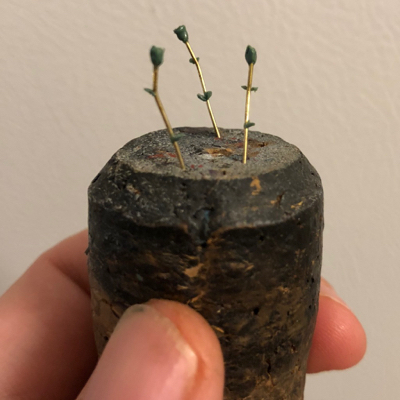
Making the roses was actually surprisingly easy. I just bent some brass wire (since stems are never perfectly straight) and sculpted the leaves and petals with color shapers.
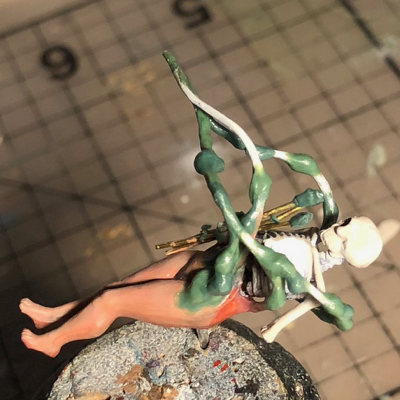
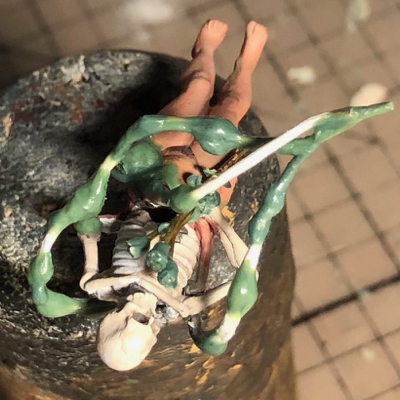
In addition to sculpting the spell effect, I also had to sculpt the corpses hands and collar-bones, since those are not part of the Secret Weapon kit.
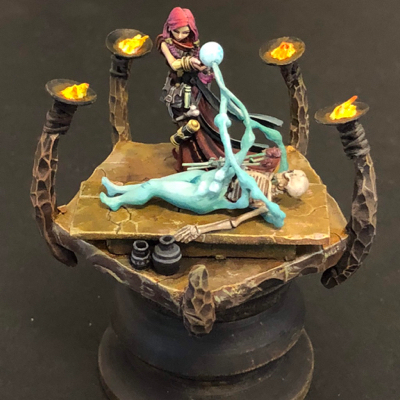
It was a bit of a disappointment to go from a miniature were all surfaces were decently far along to one with bare metal and green stuff, so it was a huge relief when I had everything covered in paint again.
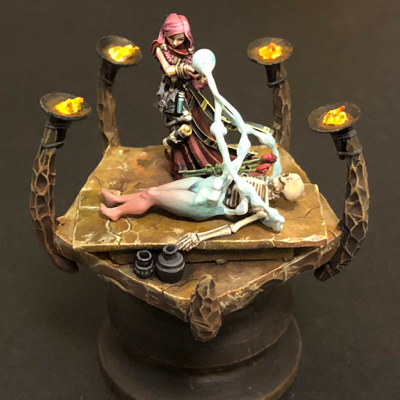
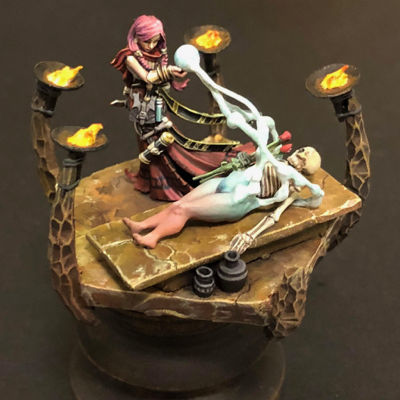
The colors changed many times as I was feeling my way towards a composition I was happy with. Sometimes you just have to try stuff out and see how it looks to see what you’re happy with, as visualizing miniatures in your mind’s eye can only go so far. Even though I was fairly happy at this point, significant changes were still in store, including completely redoing the top surfaces of the rock, changing the color of the spell effect, and adding the books.
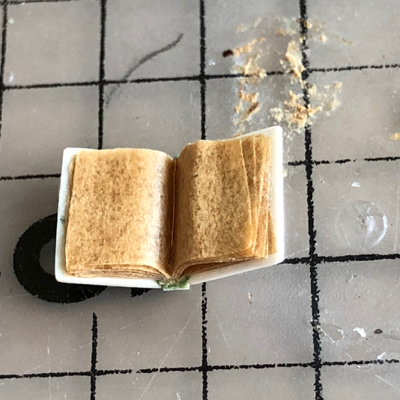
Both books are scratchbuilt, using thin plastic card and a hint of putty for the covers, and parchment paper for the pages. Parchment paper, in addition to being smoother than normal paper, is more durable, and slightly translucent. I was lucky enough to have some brown parchment lying around which was a perfect color for old, worn pages.
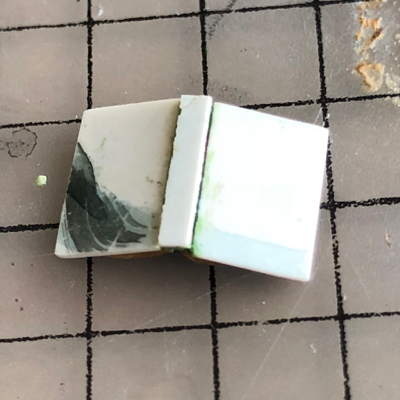
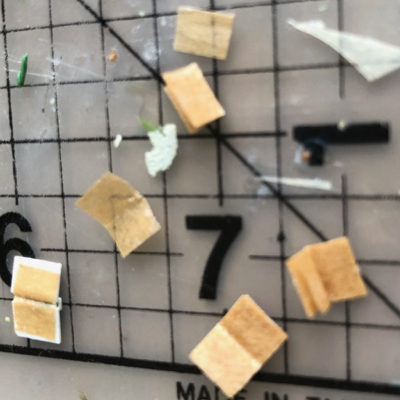
Lots of careful tweezer work during construction! Getting all of the pages the same size and lined up was a bit of a pain, but worth it.
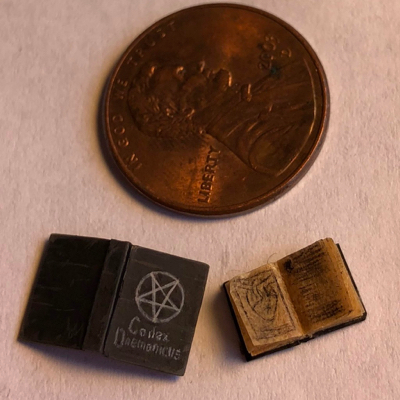
Of course painting these was extremely fiddly as well. This is damn close to the maximum resolution I can wield a brush at.
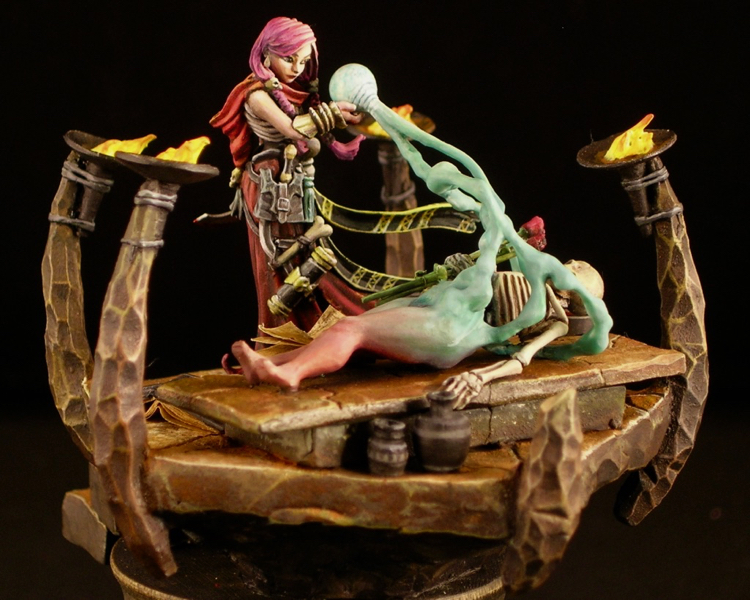
With the addition of the books and some final work to bring everything together, I was ready to call her finished. But I’m also a big believer in critiques, so I circulated photos to a number of my mini painter friends in order to get their takes, before calling things finished.
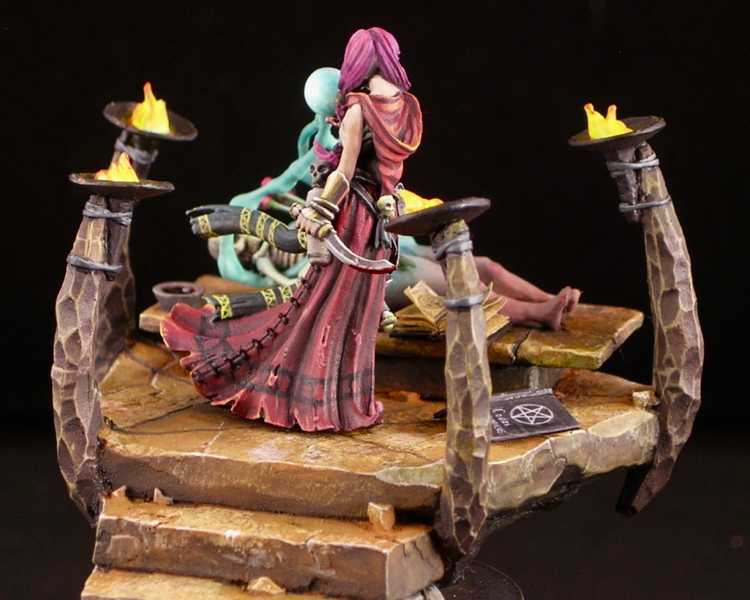
The resounding comment from everyone I showed photos to was that they wanted some OSL. Even though there were four torches and a spell effect that could be casting light, I had depicted the scene as if the ambient light was bright enough to overpower the object sources. Ben Kantor’s critique, in particular, was extremely helpful. He used photoshop to suggest a darker, grittier ambience, with much more of the light coming from the sources in the scene. I debated back and forth whether I should follow this advice, but in the end I decided to go for it.
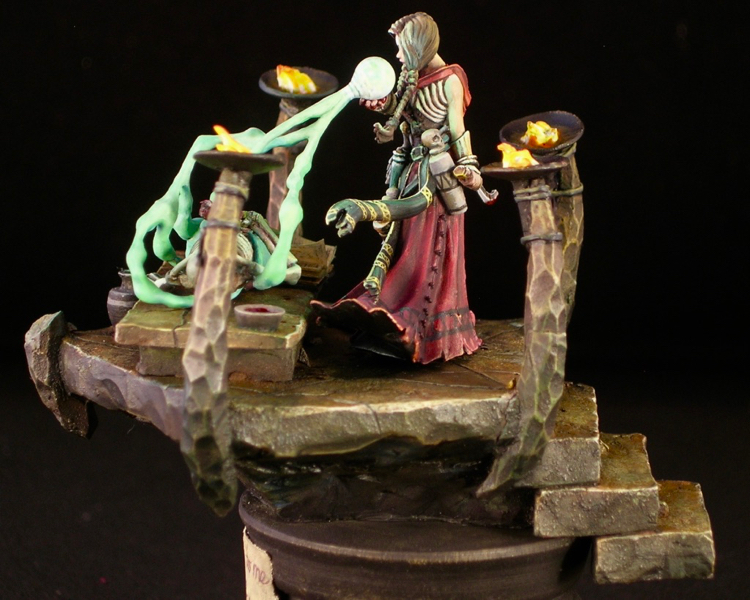
In order to make the OSL work, I needed to make the stone work much darker, with a bit of a greenish hue from the spell effect. This actually was not hard to accomplish: I grabbed a large brush, mixed some Reaper green liner with black pigment, and put a thin glaze over almost all of the stone. I avoided covering the upper parts of the columns with the torches, as I imagined they would receive some orange light from the torch glow to cancel out the green. I also used nightshade purple instead of green liner in the glaze in the places where the green light from the spell effect wouldn’t reach.
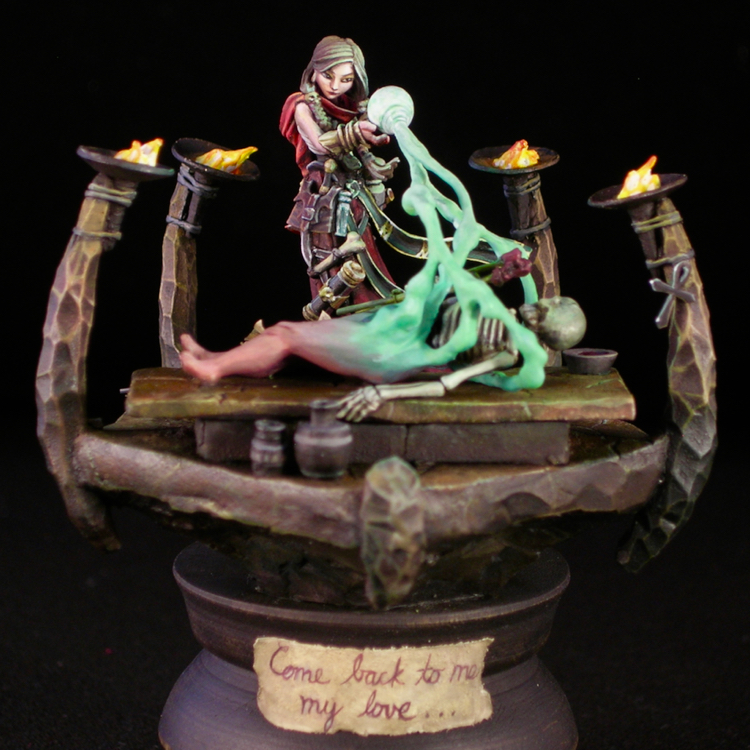
I also added a label to the base. This has two purposes: it clearly indicates what side is the front, and it informs the viewer of the title of the piece, which adds to the story. On the occasions when I include a title plaque, I try to tie it in with the piece somehow. In this case, I painted it as if it were a handwritten note from the necromancer to her beloved.
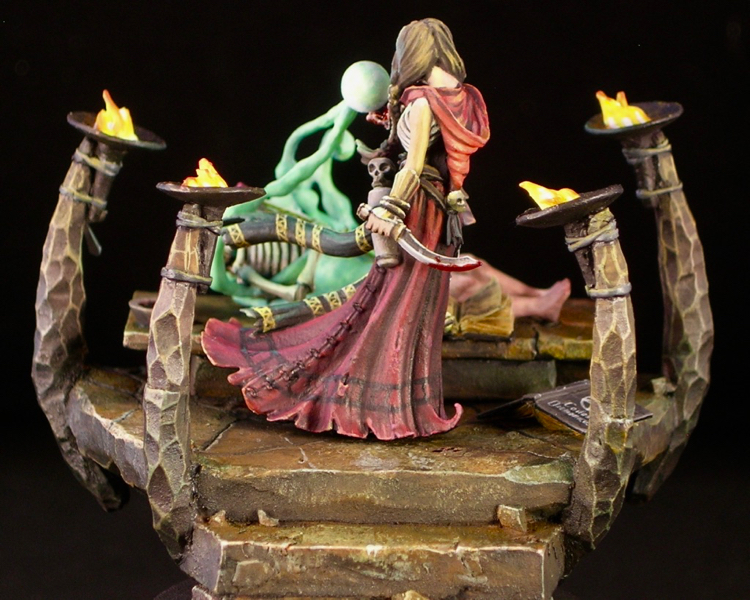
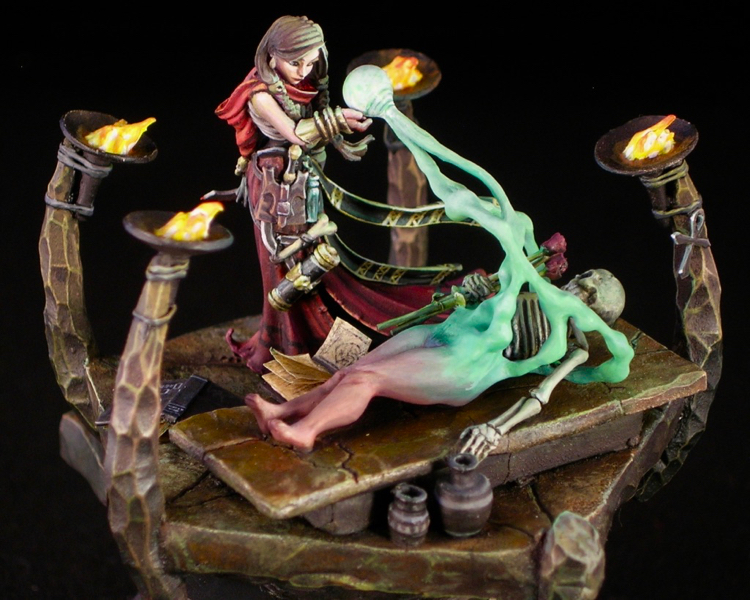
I tried to squeeze in a lot of storytelling elements, which rewards the attentive viewer.
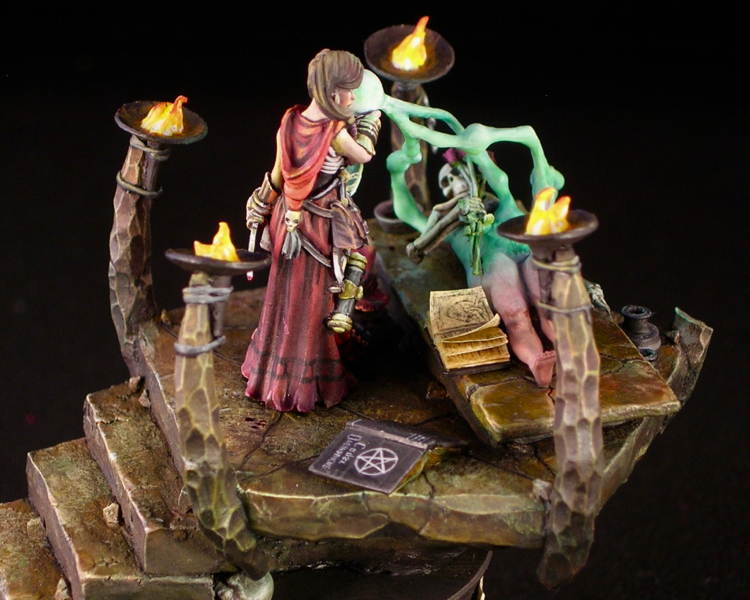
I kept the OSL itself relatively subtle, in order to keep the focus on other elements. I made it most noticeable on the hair. It makes sense to do that because hair is shiny and tends to reflect light, and it’s an effective thing to do because it makes the head more of a focus.
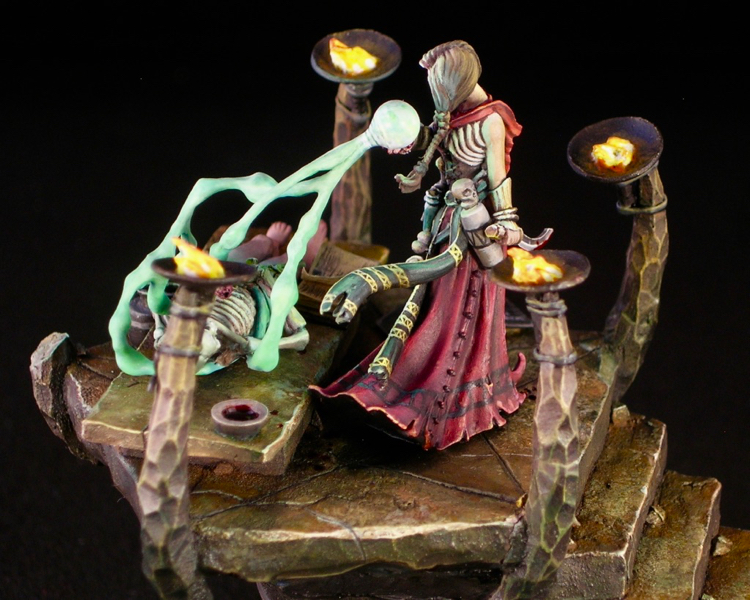
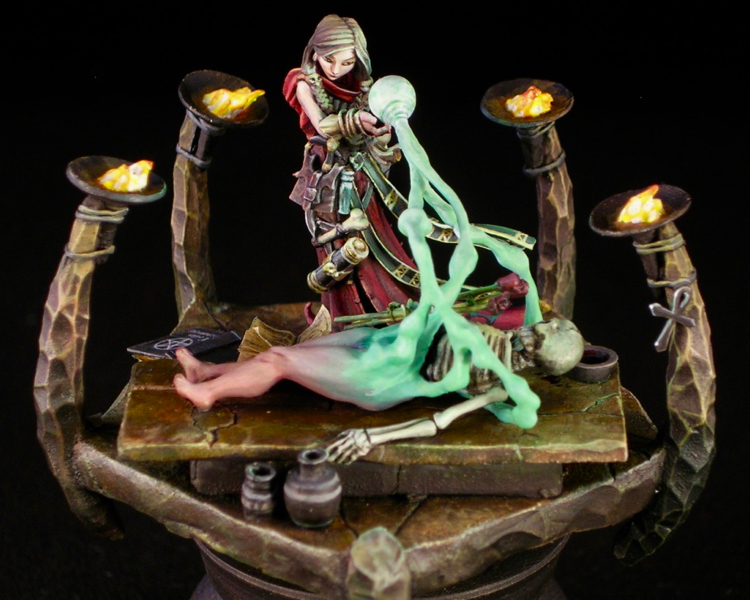
I received many nice compliments for this piece at ReaperCon, and was lucky enough to end up with runner-up for Reaper Best of Show, and gold Sophie for best Reaper Diorama. I was hoping to improve upon the bronze Sophies I received in the last two years, so I was super excited to end up with not only a gold Sophie, but actually snagged one of the best-of-show awards, finishing after the legendary Doug Cohen. You can see all the entries and awards here.

Number of blood sacrifices involved in constructing Come back to me, my love…: One. Of course I sliced my thumb open at one point, since that’s pretty much inevitable for any serious miniature project. I think it was while I was building the base. And of course I made sure to spill some on the model. For luck, and/or to appease the dread god Osiris. Shockingly, no blood sacrifices were needed to construct either Codex Daemonicus or Codex Necronomicon (the two books).
Introducing “Light Miniatures”

You may have noticed that “althaipaints.net” is now “lightminiatures.com.” Why? Frankly, I got tired of telling people how to spell “althai.” Hopefully the new name will be easier to remember. Why “Light Miniatures”? Playing with light has been a consistent theme in my miniature painting for the last several years, starting with Ruby in 2011 where I set the scene in the late afternoon “Golden Hour,” and especially noticeable in recent works such as Steampunk Leia, Black Arts, and Abalám.

The old domain should continue to work and redirect to the new domain for the next year, until the new domain is firmly established. And I plan to post several times in the next couple of weeks to give people a chance to get used to coming to the new location. There might be a few broken links or images in the next few minutes before the DNS updates with the new settings. If that happens, try clicking on the “Light Miniatures” banner at the top of the page to go to the new domain. After that, please let me know if you see any errors, such as broken links or images, as a result of this transition. I tried to fix everything ahead of time, but there are usually a few things which get lost in translation. 😊

“Negative Space”—finished

Negative Space

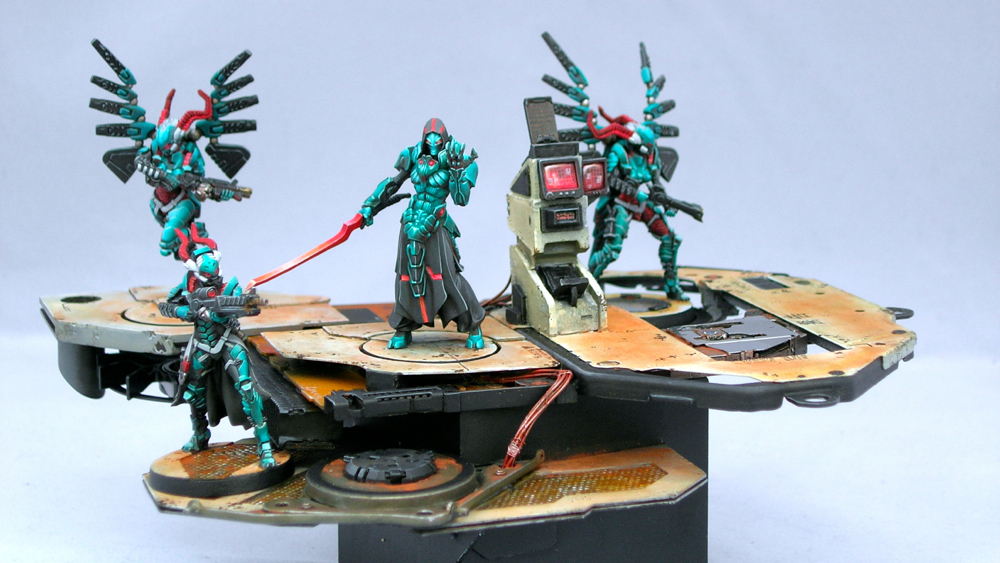
As soon as I saw the new Infinity—Combined Army starter pack in my local game store, I wanted to paint it. In fact, that was the box that ended up getting me started on my recent Infinity kick. I have to say the models are fantastic, light-years ahead of the older Infinity models; they are very easy to clean, and tremendously fun to paint.

Negative Space

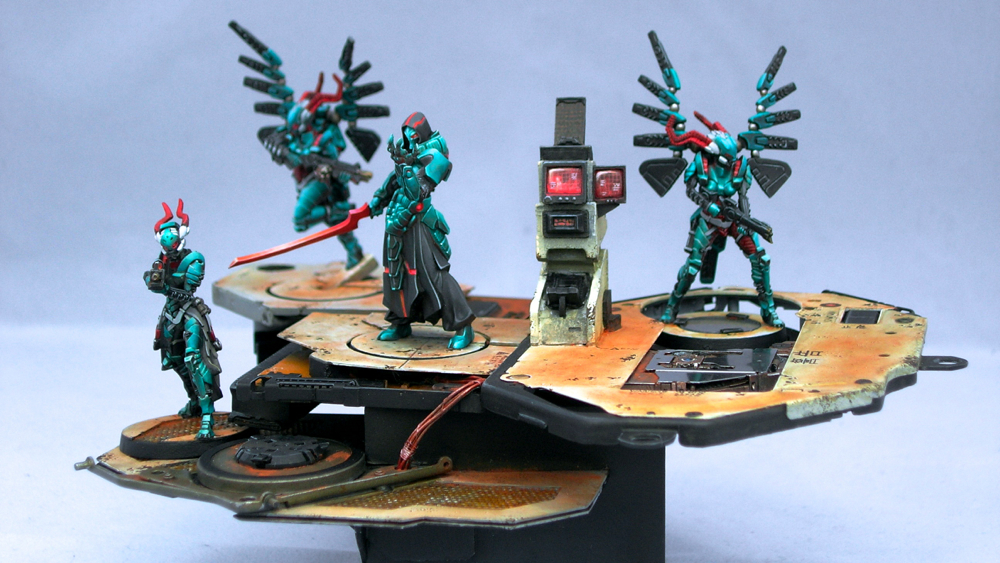
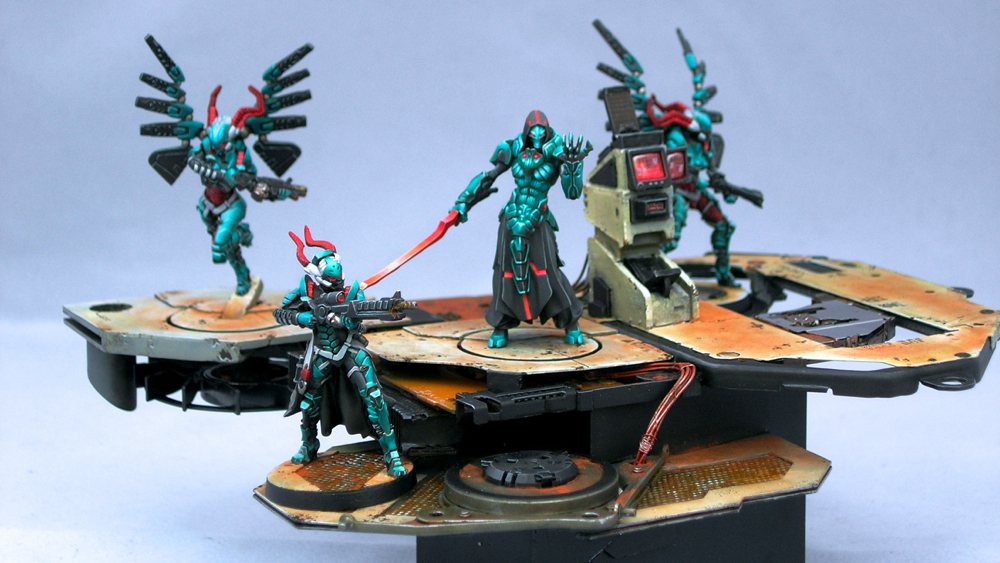
The base was the first thing I built, and is primarily composed of parts of the optical drive and heat sink from my old MacBook (which I replaced once it started constantly crashing), mounted on a resin block from Secret Weapon miniatures. The base presented some interesting engineering challenges, to make it structurally sound where a thin piece of plasticard was sticking out from a resin block and just attached at the edge, so I added some plasticard braces and carved a groove in the resin block for extra support.

Negative Space

The miniatures are all magnetized to the base, so that they can be removed to be usable as gaming pieces or just be appreciated on their own, but snap nicely onto the base in the appropriate position and orientation for group display. This was especially nice for entering into the Gen Con competition, which requires units to be presented together on a display base. Making everything nice and stable as a unit also makes things safer when being handled by the judges and their minions.

Negative Space: Fraacta, Umbra Legates, Maakrep, Fraacta

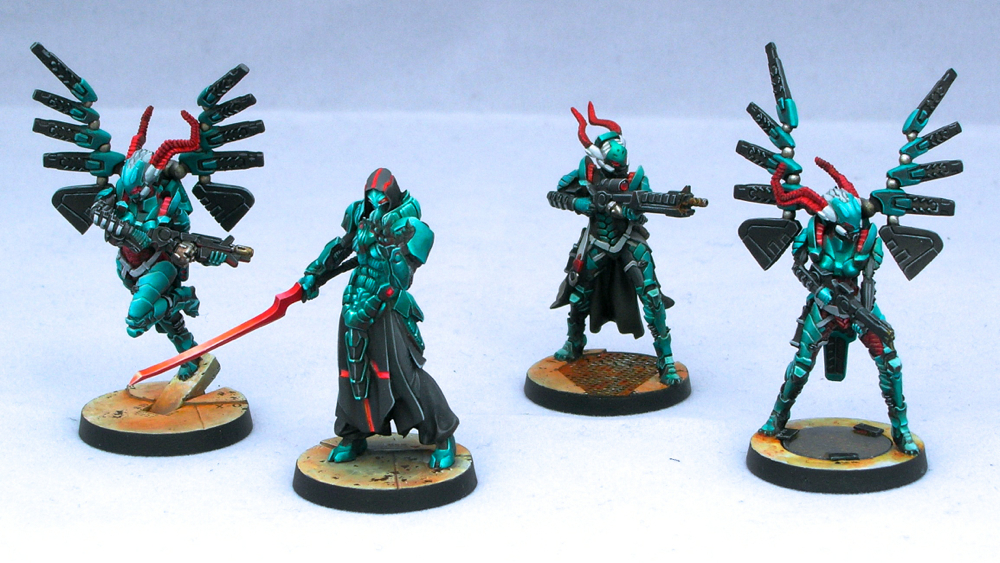
From left to right: Fraacta, Umbra Legates, Maakrep, Fraacta.

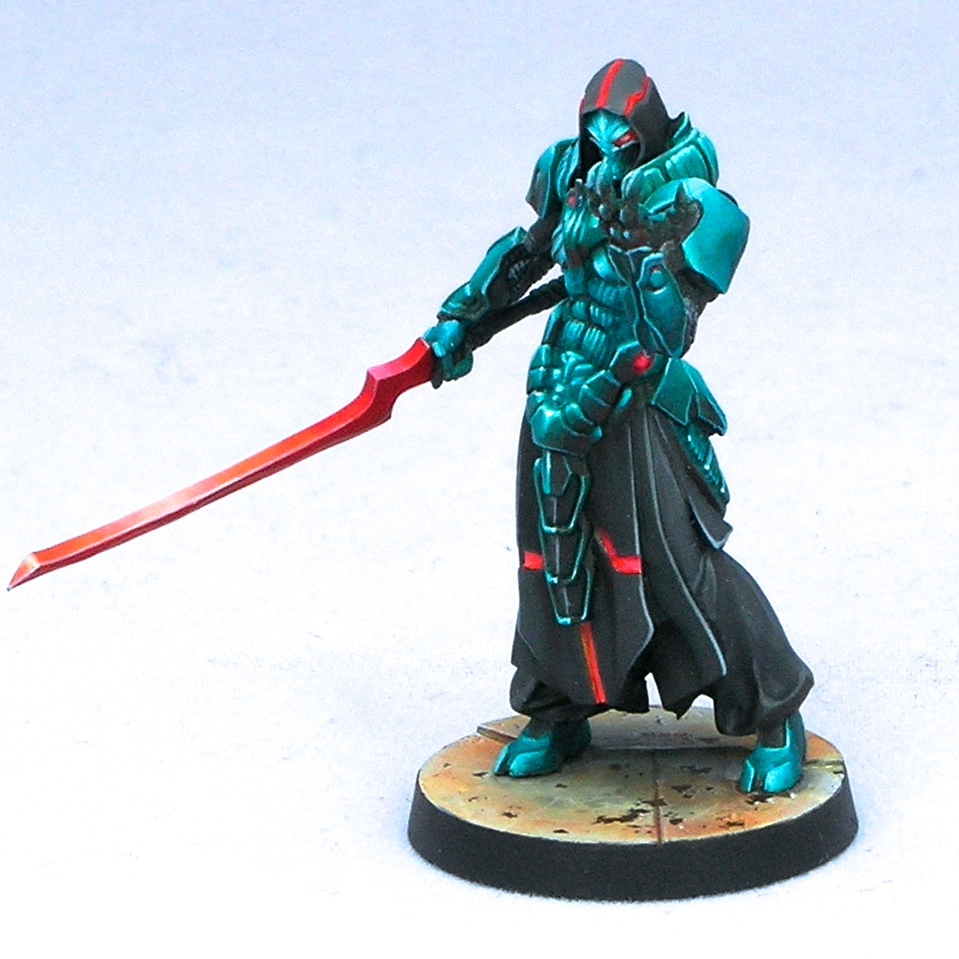
Negative Space: Umbra Legates

Originally I intended to paint the entire box up as a unit, but ended up dropping the Unidrons and adding an extra Fraacta. The base I built was not really large enough for six models, I wasn’t really happy with the first Unidron I painted up, and I really liked the new Fraacta model that had just come out.

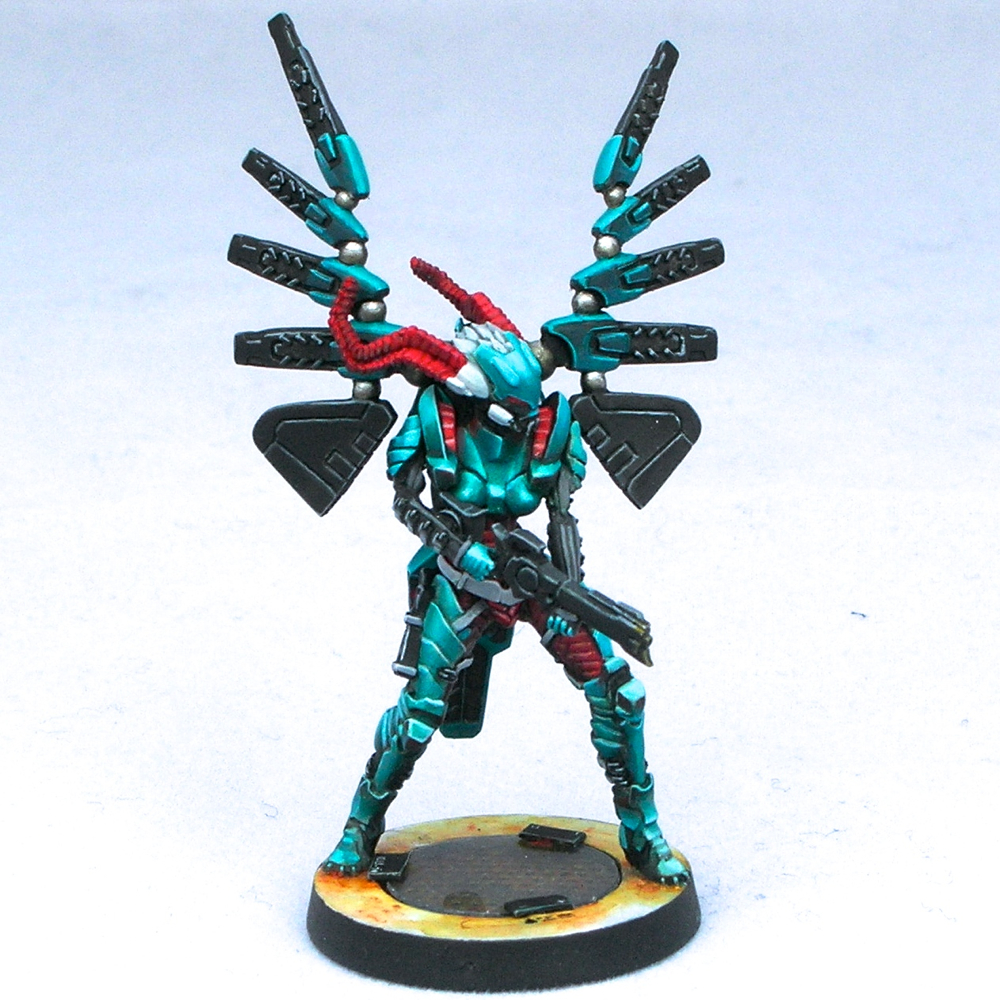
Negative Space: Fraacta

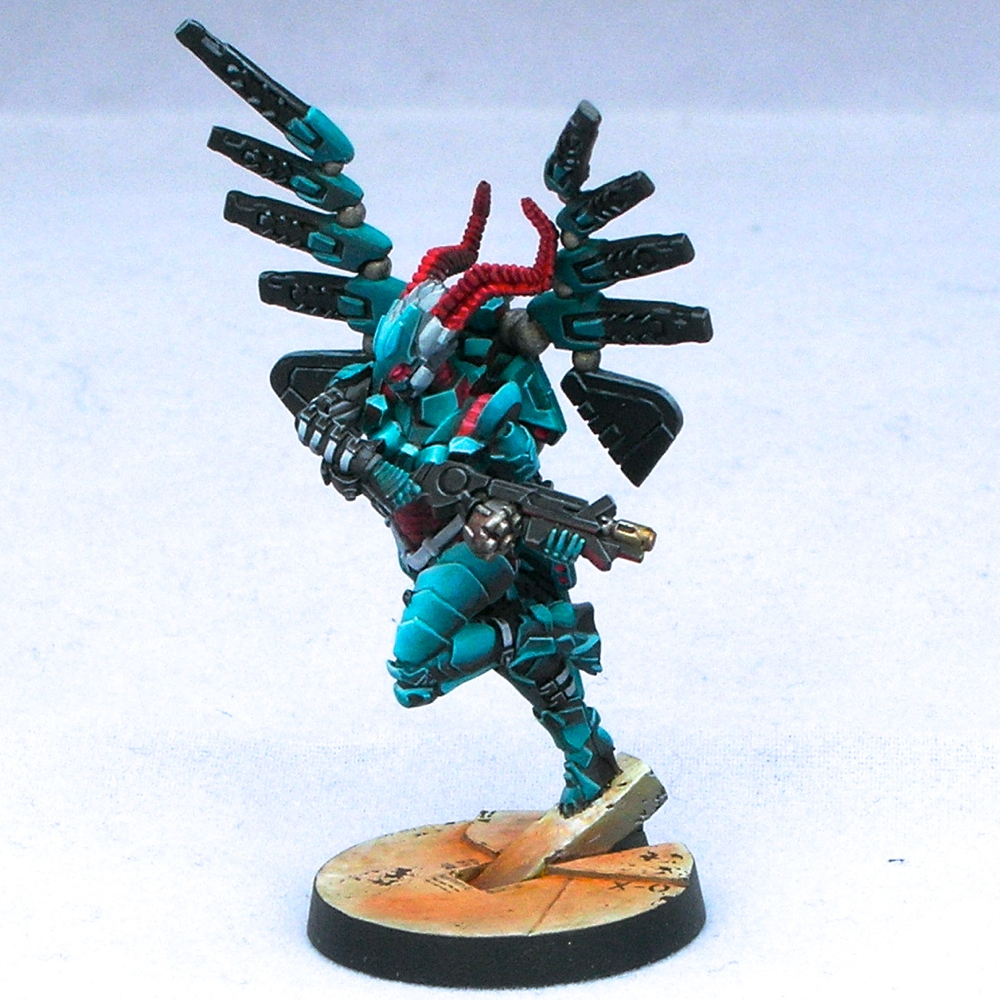
The running Fraacta was the last model I painted, and turned out the best because I had the color scheme down at that point. In the sculpt, the Fraacta is jumping off of some weird, pseudo-organic piece of rock. In order to make it match the base, I had to completely resculpt that rock to look mechanical, and then incorporate it into the base in such a way that it looked at least plausible for it to be mounted at that angle. I ended up cutting a big hole in the base to make it look like a part which could be rotated out to provide access to something underneath.

Negative Space: Fraacta

It’s hard to appreciate from the photos, but three of the four models have holes going all of the way through the bases. My favorite is the base of the standing Fraacta, where I carved out a circle from the middle of the base, and mounted a brass-etch grate and a clear piece of plastic (from a blister pack). I think incorporating negative space into most of the miniatures’ bases as well as the group display base makes them hang together really well as a unit.

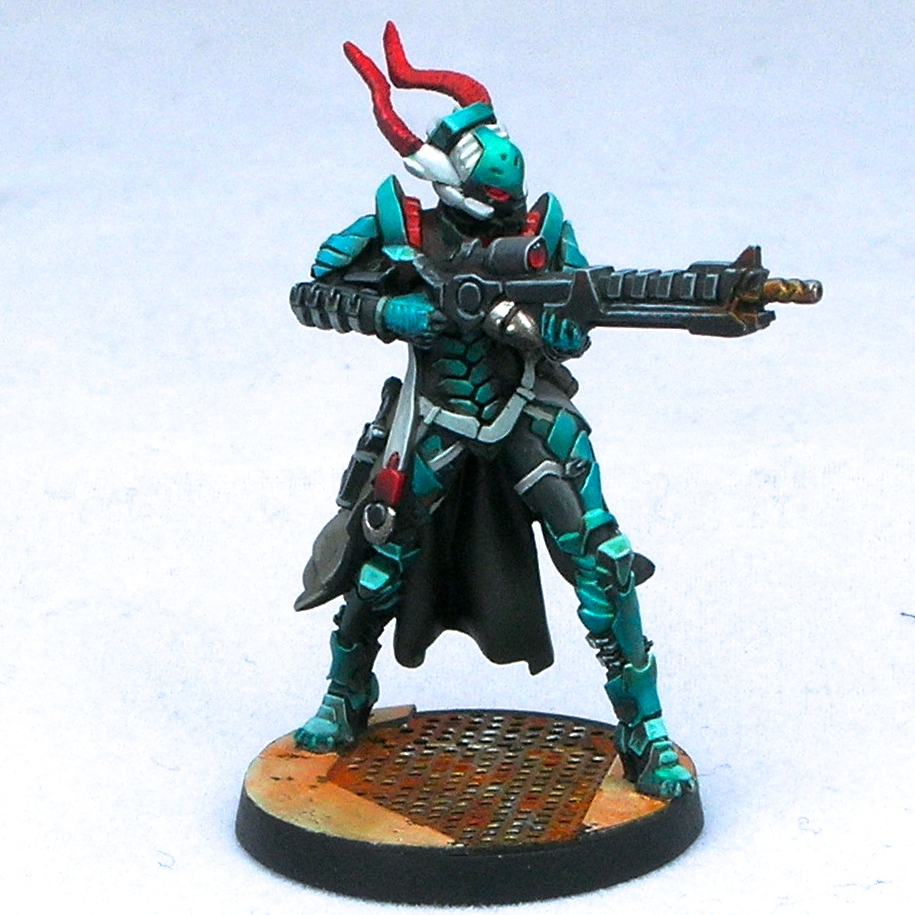
Negative Space: Maakrep

The Maakrep was the first miniature I painted of the group, and ended up much greener than the others. I painted the standing Fraacta second, and that was when I really nailed the color scheme down. I ended up having to go back to the Maakrep and add a lot of turquoise glazes so that the colors would match.


This piece won first place in the unit category of the Gen Con painting competition, and was awarded a gold under their open judging format. Additionally, Angel Giraldez, the studio painter for Infinity, was at the con, and told me that he really liked my entry, which was very flattering. Thanks Angel!

© 2026 Light Miniatures

Theme by Anders NorenUp ↑